
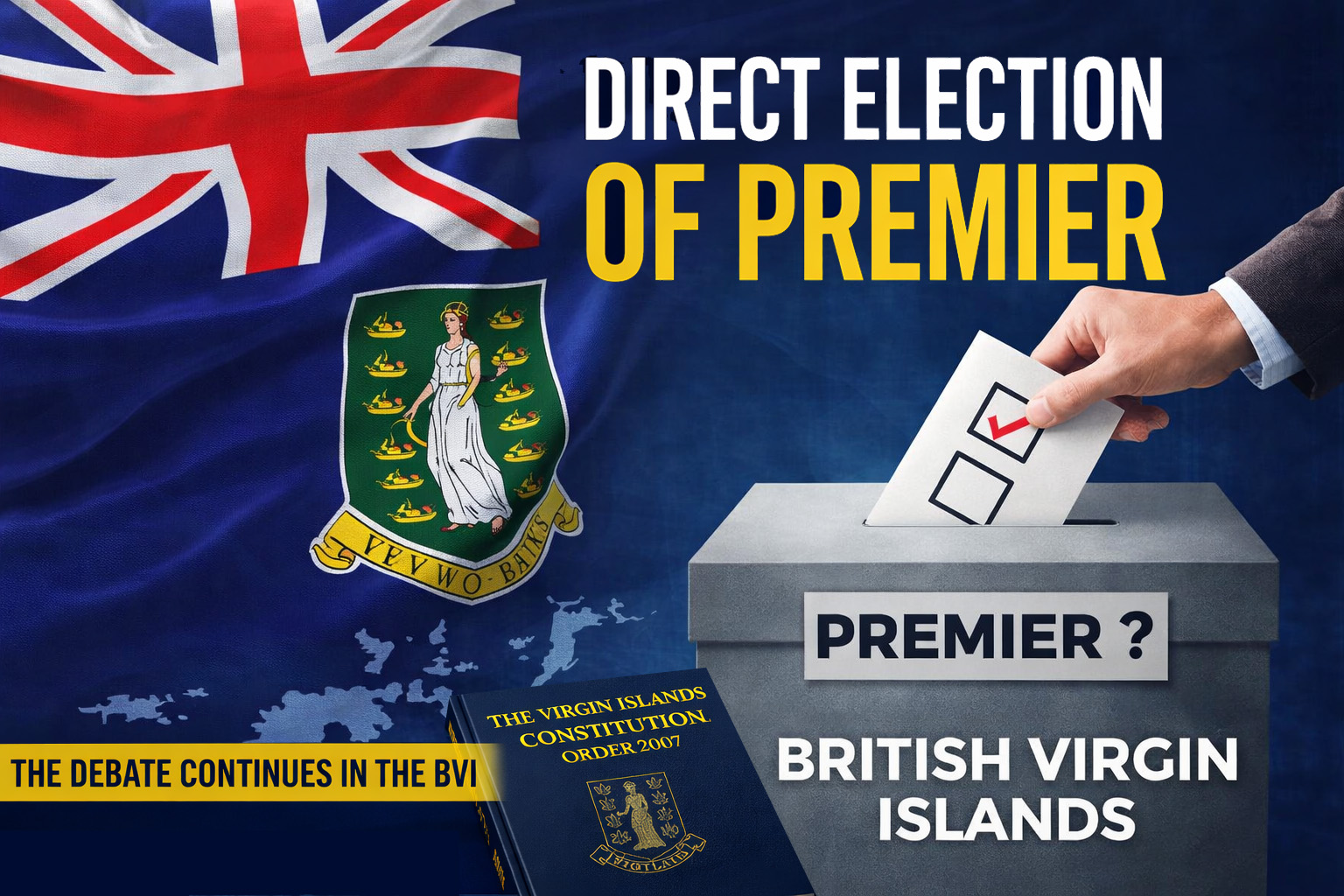
Growing public calls for the direct election of the Premier are highlighting tensions between voter expectations and the constitutional structure of governance in the Virgin Islands, where the head of government is not elected by popular vote but appointed through a parliamentary process.
Speaking on the April 14 broadcast of Honestly Speaking on ZBVI Radio, host Claude Skelton Cline pointed to increasing public support for selecting the Premier directly, describing it as part of a broader demand for political reform. “I am with the people of this country on matters such as voting for the Premier,” he said.
Under the current system, the Premier is not chosen by voters in a direct election. Instead, the Governor appoints the leader of the political party or coalition that commands a majority in the House of Assembly. This arrangement reflects the Virgin Islands’ parliamentary model, which is rooted in the British Westminster system.
Skelton Cline said many residents may not fully understand that implementing direct elections would require fundamental changes to that system. “Some of these changes that you are asking for will require a change in the very system in which our constitution is set down,” he said.
He added that such a shift would involve structural reforms beyond simple legislative amendments. “This requires structural and systemic change,” Skelton Cline said, noting that the current framework operates within constitutional limits that are influenced by the United Kingdom.
The Virgin Islands operates as a parliamentary democracy under the Virgin Islands Constitution Order, 2007, with executive authority formally vested in the British monarch and exercised locally through the Governor. While the territory has internal self-governance, significant constitutional changes require approval from the United Kingdom.
Debate over governance reforms has intensified in recent years, particularly following the work of the Constitutional Review Commission, which examined ways to modernize the territory’s political system and respond to public concerns about representation and accountability.
Skelton Cline said the current discussion reflects a broader desire among residents for greater involvement in leadership selection but warned that expectations must be aligned with legal and constitutional realities. “Why are you continuing to purchase a nine-inch shoe when your feet have grown to twelve?” he said, using an analogy to describe what he sees as a mismatch between public demands and the existing governance framework.
He urged government officials to provide clearer guidance to the public on what reforms are feasible and what steps would be required to achieve them. “Somebody needs to say to the people of this country… here is what needs to happen,” he said.
The issue is expected to remain central to ongoing constitutional discussions, as policymakers weigh public calls for reform against the legal and institutional structure that defines governance in the territory.
ADVERTISEMENT: